
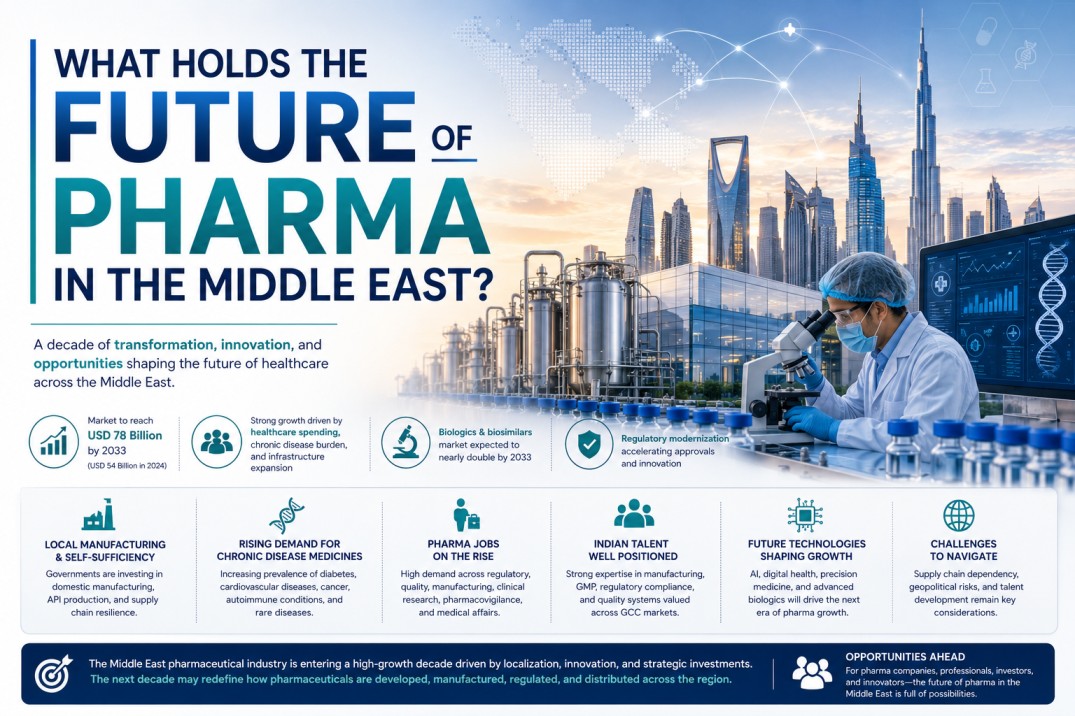
What Holds the Future of Pharma in the Middle East?
The pharmaceutical industry in the Middle East is entering one of the most transformative periods in its history.
For decades, many countries across the Gulf Cooperation Council (GCC) region relied heavily on imported medicines, international manufacturing networks, and overseas pharmaceutical innovation. Today, that model is changing rapidly.
Governments across Saudi Arabia, the UAE, Qatar, Egypt, and other Middle Eastern nations are investing heavily in local pharmaceutical manufacturing, biotechnology, digital healthcare, regulatory modernization, and healthcare infrastructure.
For pharmaceutical companies, healthcare investors, regulatory professionals, manufacturing experts, and job seekers, the Middle East is becoming a region that cannot be ignored.
The next decade may redefine how pharmaceuticals are developed, manufactured, regulated, and distributed across the region.
Why the Middle East Pharma Market Is Growing Rapidly
Several structural factors are driving pharmaceutical growth across the Middle East.
Rising Healthcare Spending
Healthcare expenditure continues to increase across GCC countries due to:
Growing populations
Increasing life expectancy
Rising chronic disease burden
Expansion of healthcare infrastructure
Government-backed healthcare reforms
Saudi Arabia and the UAE are leading this transformation through large-scale investments in healthcare modernization programs.
Growing Demand for Chronic Disease Medicines
The region is witnessing a significant increase in:
Diabetes
Cardiovascular diseases
Obesity-related disorders
Cancer
Autoimmune conditions
As disease prevalence rises, demand for innovative medicines, specialty therapies, biologics, and advanced treatment solutions continues to grow.
Shift Toward Healthcare Self-Sufficiency
One of the biggest trends reshaping the Middle East pharmaceutical industry is localization.
Governments no longer want to rely entirely on imported medicines.
Instead, they are encouraging:
Local pharmaceutical manufacturing
Technology transfer partnerships
Domestic API production
Regional supply chain development
Research and development collaborations
Industry leaders have emphasized that reducing dependence on imported raw materials and finished formulations is becoming a strategic priority across the region.
Middle East Pharma Market Forecast: What to Expect by 2033
According to industry estimates, the Middle East pharmaceutical market was valued at approximately USD 54 billion in 2024 and is projected to reach nearly USD 78 billion by 2033.
Key growth drivers include:
Government healthcare spending
Expansion of hospital infrastructure
Increased insurance penetration
Growing specialty medicine demand
Rising adoption of biologics and biosimilars
Digital health transformation
This sustained growth is creating major opportunities for pharmaceutical companies expanding their international footprint.
The Rise of Biologics and Biosimilars in the Middle East
One of the most important developments shaping the future of pharma in the Middle East is the growing focus on biologics and biosimilars.
Industry analysts project the Middle East biologics and biosimilars market to nearly double by 2033.
Major therapeutic areas driving demand include:
Oncology
Autoimmune diseases
Metabolic disorders
Rare diseases
Specialty care therapies
Governments increasingly view biosimilars as a way to improve patient access while reducing healthcare expenditure.
This trend is expected to create strong demand for professionals skilled in:
Biologics manufacturing
Quality assurance
Regulatory affairs
Pharmacovigilance
Clinical research
Biotechnology
Regulatory Transformation Is Accelerating
Historically, regulatory complexity slowed pharmaceutical market entry across many Middle Eastern countries.
That landscape is changing rapidly.
Regulatory agencies are increasingly:
Adopting international standards
Digitalizing submission processes
Streamlining approvals
Aligning with US FDA and EMA frameworks
Accelerating review timelines for innovative therapies
Industry experts report that regulators are moving toward greater harmonization and faster decision-making for advanced therapies and biologics.
This creates significant opportunities for professionals specializing in:
Regulatory Affairs
eCTD Submissions
Global Regulatory Strategy
Medical Writing
Pharmacovigilance
Local Manufacturing Is Becoming a Strategic Priority
The COVID-19 pandemic exposed vulnerabilities in global pharmaceutical supply chains.
Middle Eastern governments are responding by encouraging domestic pharmaceutical production.
Key priorities include:
Pharmaceutical Manufacturing Expansion
New facilities are being developed for:
Solid dosage manufacturing
Sterile injectables
Vaccines
Biosimilars
Specialty pharmaceuticals
Technology Transfer Partnerships
Global pharmaceutical companies are increasingly partnering with regional manufacturers to accelerate local production capabilities.
R&D Investments
Countries such as the UAE are investing heavily in:
Pharmaceutical innovation
Research centers
Life sciences ecosystems
Healthcare technology clusters
These initiatives are transforming the region from a medicine-importing market into an emerging pharmaceutical innovation hub.
Pharma Jobs in the Middle East: Hiring Trends for 2026 and Beyond
As pharmaceutical investment accelerates, hiring demand is increasing across multiple functions.
Some of the fastest-growing pharmaceutical job categories include:
Regulatory Affairs
Companies expanding across GCC markets require professionals capable of navigating country-specific regulations and submissions.
Quality Assurance & Quality Control
Manufacturing expansion continues to increase demand for experienced QA and QC professionals.
Production & Manufacturing
Local manufacturing facilities require:
Production Officers
Manufacturing Executives
Plant Managers
Validation Specialists
Engineering Professionals
Clinical Research
Growing innovation and specialty drug development are driving demand for:
Clinical Research Associates
Medical Advisors
Clinical Operations Professionals
Pharmacovigilance
As specialty medicines enter the market, drug safety monitoring becomes increasingly critical.
Medical Affairs
Medical Science Liaisons and Medical Affairs professionals are becoming strategic assets for multinational pharmaceutical companies.
Why Indian Pharma Professionals Are Well Positioned
India remains one of the world's leading pharmaceutical talent hubs.
Middle Eastern pharmaceutical organizations frequently recruit Indian professionals because of expertise in:
Generic manufacturing
Regulatory compliance
USFDA-approved facilities
GMP systems
API manufacturing
Formulation development
Clinical research
Quality systems
With strong pharma manufacturing ecosystems in Ahmedabad, Hyderabad, Mumbai, Pune, Baddi, and Vizag, Indian professionals possess highly transferable skills that align with GCC market requirements.
Challenges That Could Shape the Industry
Despite its strong growth trajectory, several challenges remain.
Supply Chain Dependency
Many Middle Eastern pharmaceutical markets still rely heavily on imported APIs and raw materials. Industry leaders estimate that a significant portion of raw material sourcing continues to come from India and China.
Geopolitical Risks
Regional tensions can impact:
Logistics
Air cargo movement
Cold chain transportation
Pharmaceutical exports
Medical supply availability
Recent industry reports have highlighted concerns regarding pharmaceutical transportation and shipping routes across the region.
Talent Development
The industry requires continued investment in:
Biotechnology talent
GMP specialists
Regulatory experts
Biologics manufacturing professionals
Addressing these skill gaps will be critical for long-term sustainability.
Future Technologies Reshaping Middle East Pharma
The next generation of pharmaceutical growth in the Middle East will likely be driven by:
Artificial Intelligence
AI-powered drug development and healthcare analytics are receiving increasing attention.
Digital Health
Governments are rapidly adopting:
Telemedicine
Digital therapeutics
Electronic health records
AI-driven diagnostics
Precision Medicine
Personalized therapies and targeted treatments are expected to become major growth areas.
Advanced Biologics
Biologics, gene therapies, and specialty medicines are emerging as key strategic priorities across the region.
Key Takeaways
The Middle East pharmaceutical market is entering a high-growth phase.
Localization and domestic manufacturing are becoming national priorities.
Biologics and biosimilars represent the next major growth segment.
Regulatory modernization is accelerating approvals and innovation.
Demand for skilled pharmaceutical professionals continues to rise.
Indian pharma talent remains highly valued across GCC markets.
Technology, digital health, and biotechnology will shape the next decade of growth.
Explore Pharma Career Opportunities with BIG PHARMA JOBS
As pharmaceutical investment expands across the Middle East and global healthcare markets, skilled professionals are becoming increasingly valuable.
BIG PHARMA JOBS, powered by BIG IDEAS HR Consulting Pvt. Ltd., connects pharmaceutical professionals with leading employers across manufacturing, quality, regulatory affairs, R&D, clinical research, pharmacovigilance, biotechnology, and healthcare sectors.
With 16+ years of recruitment expertise, 25,000+ successful placements, and partnerships with 1,000+ pharmaceutical companies, BIG PHARMA JOBS helps professionals discover meaningful career opportunities in India and international pharmaceutical markets.
Stay updated with the latest pharma jobs, hiring trends, and industry opportunities to accelerate your pharmaceutical career.
Weekly newsletter
Get the latest blog updates, practical hiring insights, and featured reads delivered straight to your inbox.
Read about our Privacy Policy.