
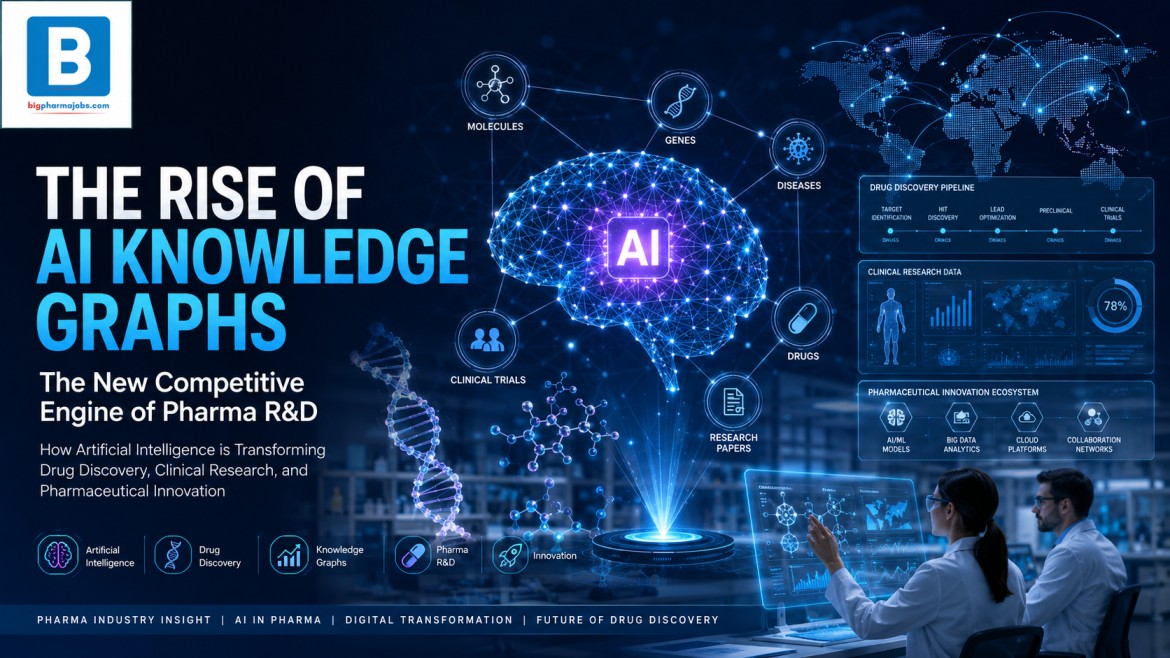
The Rise of AI Knowledge Graphs in Pharma R&D: The New Competitive Engine Driving Drug Discovery
The pharmaceutical industry has never suffered from a lack of data.
In fact, the opposite is true.
Every year, pharmaceutical companies generate billions of data points through clinical trials, research studies, regulatory submissions, patient records, scientific publications, genomic databases, safety reports, and manufacturing operations.
Yet despite having access to unprecedented amounts of information, one challenge continues to slow innovation:
The data exists, but the knowledge remains disconnected.
A clinical trial may reveal important insights.
A scientific paper may identify a promising biological target.
A real-world patient study may uncover unexpected treatment outcomes.
A regulatory submission may contain valuable safety observations.
But when these insights remain isolated in separate systems, organizations struggle to unlock their full value.
This is where AI-powered knowledge graphs are changing the future of pharmaceutical research and development.
Many industry leaders now view knowledge graphs as the next major competitive advantage in pharma—one capable of accelerating drug discovery, improving decision-making, reducing R&D costs, and increasing the probability of scientific success.
What Are AI Knowledge Graphs?
At their core, knowledge graphs are systems that connect information in a way that mirrors how humans understand relationships.
Instead of storing data in isolated databases, knowledge graphs create networks of interconnected information.
Imagine a pharmaceutical researcher investigating a specific disease.
A knowledge graph can automatically connect:
Genes
Proteins
Diseases
Drug candidates
Clinical trial outcomes
Scientific literature
Regulatory findings
Patient outcomes
Safety reports
Rather than searching through hundreds of separate documents, researchers can visualize how all these elements interact.
When artificial intelligence is layered on top of this structure, the system becomes even more powerful.
AI can identify hidden patterns, generate hypotheses, recommend research directions, and uncover relationships that may otherwise remain unnoticed.
Why Traditional Pharma R&D Is Reaching Its Limits
Drug development has become increasingly expensive and complex.
Today's pharmaceutical organizations face several challenges:
Data Explosion
The amount of biomedical data doubles at an extraordinary pace.
Researchers simply cannot manually process all available information.
Fragmented Information Systems
Important knowledge often resides in:
Clinical databases
Research platforms
Medical literature
Internal reports
Regulatory archives
These systems rarely communicate effectively with one another.
Rising Development Costs
Bringing a new medicine to market can cost billions of dollars and take over a decade.
Even then, failure rates remain high.
Increasing Scientific Complexity
Modern therapies involve:
Precision medicine
Genomics
Biomarkers
Cell and gene therapies
Multi-target drug mechanisms
The complexity of these areas requires a more connected approach to knowledge management.
Why AI Knowledge Graphs Are Becoming a Strategic Asset
Pharmaceutical companies are no longer competing solely on research budgets.
They are competing on how effectively they can transform information into actionable insights.
AI knowledge graphs provide several powerful advantages.
Faster Drug Discovery
Researchers can rapidly identify relationships between:
Diseases
Molecular pathways
Existing therapies
Potential drug targets
This reduces time spent searching for information and increases time spent generating insights.
Better Decision-Making
Knowledge graphs provide a single connected view of information.
Decision-makers gain access to evidence from multiple sources simultaneously.
This improves confidence in critical R&D decisions.
Reduced Research Duplication
Many organizations unknowingly repeat experiments or investigations because knowledge is scattered across departments.
Connected intelligence helps eliminate unnecessary duplication.
Identification of Hidden Opportunities
AI algorithms can detect patterns that may not be obvious to human researchers.
These discoveries can reveal:
New therapeutic targets
Drug repurposing opportunities
Potential biomarkers
Patient subgroup insights
How Leading Pharma Companies Are Using Knowledge Graphs
The adoption of AI knowledge ecosystems is accelerating across the pharmaceutical sector.
Organizations are increasingly using connected intelligence platforms to support:
Target Identification
Understanding disease biology more effectively.
Clinical Trial Optimization
Improving patient recruitment and study design.
Regulatory Intelligence
Connecting historical regulatory decisions with current submissions.
Pharmacovigilance
Detecting emerging safety signals faster.
Medical Affairs
Providing scientific teams with integrated evidence sources.
Precision Medicine
Identifying patient populations most likely to benefit from specific therapies.
The result is faster access to insights and more informed strategic decisions.
The Role of AI in Modern Knowledge Graphs
Knowledge graphs alone create valuable connections.
Artificial intelligence amplifies those connections.
AI enables systems to:
Interpret unstructured scientific literature
Analyze millions of research papers
Identify emerging trends
Predict relationships between biological entities
Generate new research hypotheses
Support scientific decision-making
This combination creates what many experts now describe as a knowledge ecosystem rather than a traditional database.
The focus shifts from storing information to actively generating intelligence.
Why This Matters for the Future of Drug Discovery
Historically, drug discovery relied heavily on human expertise and experimentation.
While expertise remains essential, the volume of available information now exceeds human processing capacity.
AI knowledge graphs help bridge this gap.
Researchers can focus on:
Scientific interpretation
Strategic thinking
Experimental design
Innovation
While AI manages:
Data integration
Pattern detection
Relationship mapping
Knowledge retrieval
This partnership between human expertise and machine intelligence may significantly improve research productivity over the next decade.
Impact on the Indian Pharmaceutical Industry
India is rapidly becoming a global pharmaceutical innovation hub.
Traditionally known for:
Generic medicines
Manufacturing excellence
Cost-efficient production
The industry is now investing heavily in:
Artificial intelligence
Data science
Digital transformation
Advanced analytics
Drug discovery platforms
As Indian pharmaceutical companies move up the innovation value chain, knowledge graph technologies could become a critical competitive differentiator.
Organizations that successfully integrate AI-driven intelligence systems may gain significant advantages in:
Drug development speed
Research productivity
Regulatory preparedness
Global competitiveness
New Career Opportunities Emerging in Pharma
The rise of AI knowledge graphs is not only transforming research.
It is creating entirely new career pathways.
Data Scientists
Professionals capable of analyzing large biomedical datasets are becoming increasingly valuable.
Bioinformatics Specialists
Experts who connect biological information with computational tools.
AI & Machine Learning Professionals
Driving predictive modeling and intelligent knowledge systems.
Clinical Data Managers
Ensuring high-quality data integration across research programs.
Regulatory Intelligence Specialists
Using connected data systems to improve submission strategies.
Medical Information Professionals
Managing scientific knowledge and evidence ecosystems.
Digital Transformation Leaders
Helping organizations adopt advanced technology platforms.
Skills Pharma Professionals Should Build Today
As AI adoption accelerates, professionals should focus on developing:
Data literacy
Digital research skills
AI fundamentals
Scientific analytics
Evidence interpretation
Cross-functional collaboration
Knowledge management expertise
The future workforce will increasingly combine pharmaceutical expertise with technology capabilities.
Challenges and Considerations
Despite their potential, knowledge graphs are not a magic solution.
Organizations still face challenges including:
Data Quality
Poor-quality data produces poor-quality insights.
Integration Complexity
Connecting multiple systems requires significant planning.
Regulatory Compliance
Data privacy and regulatory requirements remain critical.
Talent Shortages
Demand for AI and data professionals currently exceeds supply.
Companies must address these challenges carefully to realize the full value of knowledge ecosystems.
The Future of Pharma R&D Is Connected Intelligence
The pharmaceutical industry is entering a new era.
For years, success depended on collecting more data.
The next phase will depend on connecting that data more effectively.
AI knowledge graphs represent a shift from information management to intelligence generation.
Organizations that successfully build connected knowledge ecosystems may gain advantages in:
Drug discovery
Clinical development
Regulatory strategy
Patient outcomes
Innovation speed
The future pharmaceutical leaders may not be those with the most data.
They may be those who understand how to connect it.
Key Takeaways
AI knowledge graphs connect scientific, clinical, regulatory, and real-world data into a unified intelligence ecosystem.
Pharma companies are increasingly using connected intelligence to accelerate drug discovery and improve decision-making.
Knowledge graphs help identify hidden relationships, reduce research duplication, and improve R&D productivity.
AI enhances knowledge graphs through pattern recognition, predictive insights, and hypothesis generation.
Indian pharmaceutical companies are increasingly investing in AI-driven innovation platforms.
New career opportunities are emerging in data science, AI, bioinformatics, regulatory intelligence, and digital transformation.
About BIG PHARMA JOBS
BIG PHARMA JOBS, powered by BIG IDEAS HR Consulting Pvt. Ltd., connects pharmaceutical professionals with leading employers across India.
With 16+ years of pharmaceutical recruitment expertise, 25,000+ successful placements, and partnerships with 1,000+ pharma companies, BIG PHARMA JOBS helps professionals stay informed about industry trends while connecting them with high-growth career opportunities across Regulatory Affairs, Clinical Research, Quality, Manufacturing, R&D, and emerging digital health domains.
Weekly newsletter
Get the latest blog updates, practical hiring insights, and featured reads delivered straight to your inbox.
Read about our Privacy Policy.