
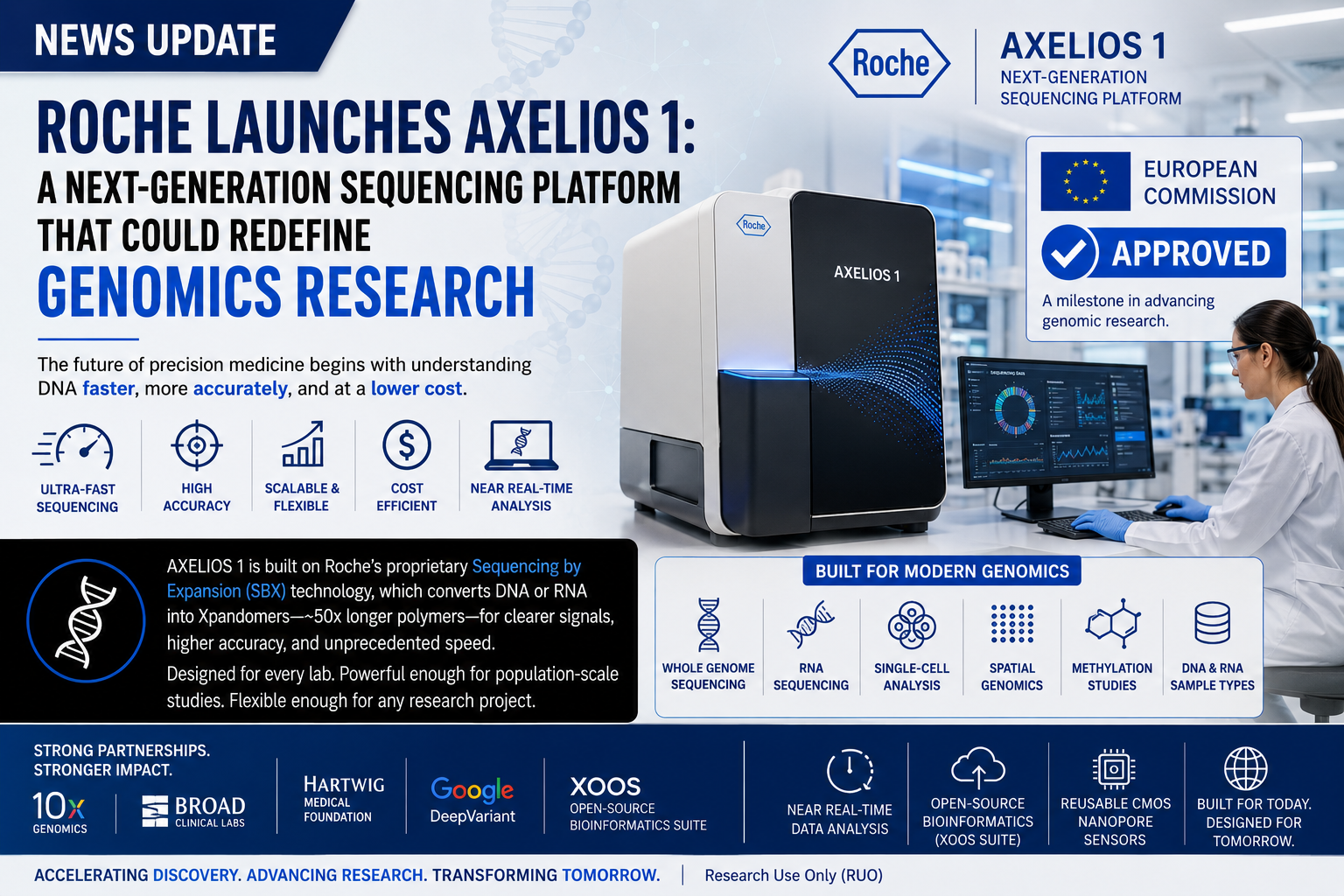
Roche Launches AXELIOS 1: A Next-Generation Sequencing Platform That Could Redefine Genomics Research
The future of precision medicine begins with understanding DNA faster, more accurately, and at a lower cost.
That is exactly what Roche aims to achieve with the launch of AXELIOS 1, its next-generation sequencing (NGS) platform powered by the company's proprietary Sequencing by Expansion (SBX) technology.
Announced from Basel, Switzerland, AXELIOS 1 is designed to address some of the biggest challenges in genomics—including sequencing speed, scalability, accuracy, flexibility, and cost efficiency. Roche believes the platform has the potential to reshape genomic research today while laying the foundation for tomorrow's clinical applications in personalized medicine.
Although currently intended for research use only (RUO), AXELIOS 1 represents one of Roche's most significant innovations in molecular diagnostics and genomics in recent years.
For researchers, pharmaceutical companies, biotechnology firms, and healthcare professionals, this launch marks an important milestone in the evolution of DNA sequencing technology.
AXELIOS 1 at a Glance
Feature | Details |
|---|---|
Company | Roche Diagnostics |
Platform | AXELIOS 1 |
Technology | Sequencing by Expansion (SBX) |
Application | Research Use Only (RUO) |
Key Benefits | High accuracy, ultra-fast sequencing, scalability, flexibility, cost efficiency |
Sample Types | DNA & RNA |
Major Applications | Whole Genome Sequencing, RNA Sequencing, Single-cell Analysis, Spatial Genomics, Methylation Studies |
Analysis | Near real-time data processing |
Bioinformatics | Open-source XOOS Suite |
Compatible Partners | 10x Genomics, Google DeepVariant |
Why Roche Introduced AXELIOS 1
Over the last decade, DNA sequencing has become central to modern biomedical research.
Scientists now depend on sequencing to:
Identify disease-causing mutations
Study cancer genomes
Track infectious diseases
Understand rare genetic disorders
Discover new drug targets
Develop personalized medicines
However, existing sequencing technologies often force laboratories to compromise between speed, throughput, cost, and flexibility.
Large genomic projects require enormous computing power and infrastructure, while smaller laboratories frequently struggle with expensive equipment and lengthy sequencing workflows.
Roche developed AXELIOS 1 to remove these barriers.
According to the company, the platform combines high accuracy with unprecedented speed and scalability, allowing laboratories to perform everything from small research projects to population-scale genomic studies using a single system.
What Makes AXELIOS 1 Different?
The biggest innovation behind AXELIOS 1 is Roche's proprietary Sequencing by Expansion (SBX) technology.
Unlike conventional sequencing approaches, SBX introduces an entirely new way of reading genetic information.
Instead of sequencing DNA molecules directly, Roche first converts DNA or RNA into specially engineered surrogate polymers known as Xpandomers.
These Xpandomers are approximately 50 times longer than the original genetic molecules.
Why is that important?
Longer molecules produce much clearer electrical signals when passing through nanopores.
This significantly improves:
Signal clarity
Sequencing accuracy
Data quality
Processing speed
The result is a sequencing workflow capable of delivering high-quality genomic information with near real-time analysis.
Understanding Sequencing by Expansion (SBX)
SBX is one of the most exciting advances in sequencing technology.
The process works in three major stages:
Step 1: DNA or RNA Expansion
The original nucleic acid sequence is converted into an expanded polymer called an Xpandomer.
Rather than reading the original molecule directly, Roche creates an enlarged version that is easier to interpret.
Step 2: Nanopore Detection
The expanded Xpandomers pass through millions of nanopores embedded within a reusable CMOS sensor.
As each molecule passes through the nanopore, unique electrical signals are generated.
Step 3: AI-Powered Analysis
Sophisticated computational algorithms rapidly decode these electrical signals into genetic sequence information.
The platform performs base calling and variant analysis almost in real time.
Together, these innovations allow researchers to obtain highly accurate sequencing data faster than traditional workflows.
Why Speed Matters in Genomics
Genomic sequencing projects often generate enormous volumes of data.
Traditional workflows may require:
Sample preparation
Library construction
Sequencing
Base calling
Bioinformatics analysis
Variant identification
Each stage can add hours—or even days—to the research process.
AXELIOS 1 aims to dramatically shorten these timelines.
According to Roche, the platform can generate whole-genome sequencing results within the same day, enabling researchers to make faster scientific decisions and accelerate discovery.
Designed for Every Laboratory
One of AXELIOS 1's biggest strengths is flexibility.
Many sequencing systems are optimized either for:
High-throughput genomic centers
or
Small laboratory studies
Rarely both.
AXELIOS 1 has been designed to handle:
Small research batches
Medium-sized sequencing projects
Large population genomics studies
without requiring laboratories to change platforms or workflows.
This flexibility allows institutions to scale research efficiently as project requirements evolve.
A Platform Built for Modern Genomics
The platform supports numerous sequencing applications, including:
Whole Genome Sequencing (WGS)
Comprehensive analysis of an individual's complete genetic code.
Whole Exome Sequencing (WES)
Focused sequencing of protein-coding regions linked to many inherited diseases.
RNA Sequencing
Studying gene expression and transcriptomics.
Single-Cell Sequencing
Understanding how individual cells behave differently within tissues.
Spatial Genomics
Mapping gene activity while preserving tissue architecture.
DNA Methylation Analysis
Investigating epigenetic modifications that influence disease development.
These capabilities make AXELIOS 1 suitable for research across multiple scientific disciplines.
Partnerships Strengthening the Platform
Rather than building an isolated ecosystem, Roche has collaborated with leading genomics organizations.
Key collaborations include:
Hartwig Medical Foundation
Supporting validation of large-scale genomic applications.
Broad Clinical Labs
Evaluating real-world sequencing performance.
10x Genomics
Developing single-cell and spatial sequencing workflows.
Google DeepVariant
Providing advanced variant-calling support.
XOOS Open-Source Bioinformatics Suite
Offering researchers flexible data analysis tools without proprietary restrictions.
These collaborations help ensure that researchers can integrate AXELIOS 1 into existing genomic workflows.
Record-Breaking Sequencing Performance
Since unveiling SBX technology in 2025, Roche has reported multiple proof-of-concept studies demonstrating applications across:
Oncology
Infectious diseases
Human genetics
RNA sequencing
Methylation analysis
Single-cell genomics
Whole genome sequencing
According to Roche, early-access users also demonstrated what the company describes as the world's fastest DNA sequencing technique, highlighting the platform's ability to process genomic data at unprecedented speed.
Why Cost Efficiency Matters
Genome sequencing has become significantly less expensive over the past decade.
Yet large-scale sequencing projects still involve considerable costs related to:
Instruments
Reagents
Data storage
Bioinformatics
Computing infrastructure
AXELIOS 1 seeks to reduce these barriers through:
Reusable CMOS sensors
Flexible sequencing workflows
High-throughput architecture
Open-source analysis software
Scalable laboratory operations
Lower sequencing costs could make genomic research more accessible to academic institutions, hospitals, biotech startups, and pharmaceutical companies.
The Growing Sequencing Market
The global sequencing market is expanding rapidly.
According to Roche, the sequencing industry is currently valued at approximately US$7.3 billion, with double-digit growth expected over the coming years.
Several trends are driving this expansion:
Precision medicine
Oncology research
Rare disease diagnostics
Pharmacogenomics
Population genomics
AI-driven drug discovery
Personalized healthcare
Infectious disease surveillance
As demand increases, next-generation sequencing platforms capable of balancing speed, scalability, and affordability will become increasingly important.
Implications for Drug Discovery
Modern pharmaceutical research depends heavily on genomic data.
Sequencing enables researchers to:
Discover new therapeutic targets
Understand disease biology
Identify biomarkers
Develop companion diagnostics
Select patients for clinical trials
Monitor treatment response
By accelerating sequencing workflows, AXELIOS 1 could help pharmaceutical companies shorten early-stage research timelines and improve decision-making during drug discovery.
What This Means for Precision Medicine
Healthcare is steadily moving toward personalized treatment strategies.
Instead of treating every patient the same way, physicians increasingly use genomic information to guide:
Cancer therapies
Rare disease diagnosis
Pharmacogenomics
Gene therapy
Biomarker-driven medicine
Although AXELIOS 1 is currently intended for research use only, Roche believes the underlying SBX technology has the potential to support future clinical applications.
If successfully translated into diagnostics, faster sequencing could eventually help clinicians make more timely treatment decisions.
Career Opportunities Emerging from Genomics Innovation
Advances in sequencing technology are creating strong demand for professionals across life sciences and biotechnology.
Growing career opportunities include:
Genomics Scientist
Bioinformatics Analyst
Molecular Biologist
Clinical Genomics Specialist
Computational Biologist
NGS Application Scientist
Data Scientist – Genomics
Medical Affairs Specialist
Regulatory Affairs Professional
Clinical Research Associate
AI in Drug Discovery Specialist
Molecular Diagnostics Scientist
As genomics becomes increasingly integrated into healthcare and pharmaceutical R&D, demand for these specialized skills is expected to continue growing globally.
Challenges Ahead
Despite its promising capabilities, widespread adoption of new sequencing technologies depends on several factors:
Independent validation by the scientific community
Integration into existing laboratory workflows
Cost of implementation
Data management infrastructure
Regulatory pathways for future clinical applications
User training and technical support
Like any new platform, AXELIOS 1 will need to demonstrate consistent performance across diverse research settings over time.
The Future of DNA Sequencing
Sequencing technology has evolved dramatically over the past two decades—from the Human Genome Project to portable nanopore sequencers and AI-assisted genomics.
AXELIOS 1 represents the next chapter in that journey.
By combining innovative SBX chemistry, reusable sensor technology, scalable architecture, and open-source bioinformatics, Roche is positioning itself at the forefront of next-generation sequencing.
Whether it ultimately transforms clinical diagnostics remains to be seen, but its potential impact on biomedical research, drug discovery, and precision medicine is already generating significant interest across the global scientific community.
Key Takeaways
Roche has launched AXELIOS 1, a next-generation sequencing platform powered by proprietary Sequencing by Expansion (SBX) technology.
The platform is designed for research use only and supports applications including whole genome sequencing, RNA sequencing, single-cell analysis, spatial genomics, and methylation studies.
SBX technology converts DNA or RNA into Xpandomers, enabling clearer signals, higher accuracy, and faster sequencing.
AXELIOS 1 offers high throughput, scalability, flexibility, and near real-time genomic analysis.
Roche has partnered with organizations including 10x Genomics, Broad Clinical Labs, Hartwig Medical Foundation, and Google DeepVariant to strengthen the platform ecosystem.
The global sequencing market is valued at US$7.3 billion and is expected to grow at double-digit rates in the coming years.
Advances in sequencing technology are expected to accelerate drug discovery, genomics research, and personalized medicine while creating new career opportunities in biotechnology and pharmaceutical R&D.
Why This Matters for Pharma Professionals
At BIG PHARMA JOBS, we track major innovations like Roche's AXELIOS 1 because they shape the future of pharmaceutical research and hiring.
As next-generation sequencing becomes faster, more scalable, and increasingly integrated with AI, the demand for professionals in genomics, molecular biology, bioinformatics, clinical research, diagnostics, and precision medicine will continue to rise.
For researchers, biotech professionals, and pharma job seekers, staying informed about technologies such as SBX sequencing isn't just about following industry news—it's about preparing for the next wave of opportunities in life sciences and healthcare innovation.
Weekly newsletter
Get the latest blog updates, practical hiring insights, and featured reads delivered straight to your inbox.
Read about our Privacy Policy.