
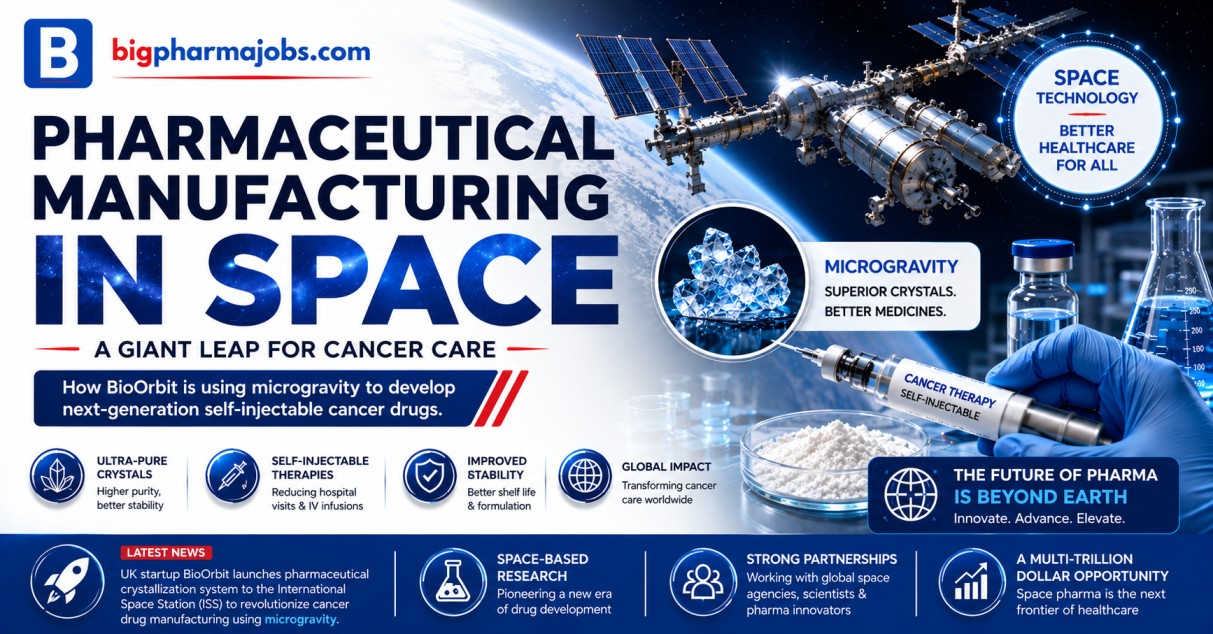
Pharmaceutical Manufacturing in Space: The Future of Cancer Drug Innovation
The global pharmaceutical industry is entering a new era of innovation — and this time, the next breakthrough may not happen on Earth.
UK-based biotech startup BioOrbit has launched a groundbreaking pharmaceutical manufacturing experiment into space with the goal of developing ultra-pure protein crystals for cancer drugs using microgravity technology. The mission could fundamentally transform how cancer therapies are produced, stored, and administered worldwide.
As pharmaceutical companies continue searching for advanced drug delivery solutions, space-based drug manufacturing is emerging as one of the most futuristic and potentially disruptive developments in modern healthcare.
What Is BioOrbit?
BioOrbit is a London-based biotechnology startup founded in 2023 by Dr. Katie King and cancer researcher Leonor Teles. The company specializes in microgravity pharmaceutical manufacturing — a process where medicines are developed in space instead of traditional Earth-based laboratories.
The company recently launched its compact crystallization system called “Box-E” aboard a SpaceX mission to the International Space Station (ISS). The device is designed to grow highly stable protein crystals in microgravity conditions.
According to BioOrbit, these crystals could enable the production of self-injectable cancer medicines that patients can use at home rather than spending hours receiving intravenous treatments in hospitals.
Why Is Space Important for Drug Manufacturing?
One of the biggest challenges in biologic drug manufacturing is crystallization quality.
On Earth, gravity affects how protein molecules arrange themselves during the crystallization process. This often creates unstable or imperfect crystal structures for complex biologic drugs such as antibody-based cancer therapies.
In space, however, microgravity allows molecules to crystallize in a much more ordered and stable manner.
This creates several pharmaceutical advantages:
Higher purity protein crystals
Better drug stability
Lower viscosity formulations
Improved shelf life
Easier self-injection delivery systems
Reduced hospital dependency
BioOrbit believes this process could completely reshape the future of biologic medicines and cancer therapy delivery.
How Space-Manufactured Cancer Drugs Could Change Healthcare
Currently, many advanced cancer therapies require:
Intravenous (IV) administration
Long hospital visits
Specialized infusion centers
Cold-chain logistics
Medical supervision during treatment
According to BioOrbit, microgravity-grown crystals could allow many of these therapies to become compact self-injectable medicines that patients can store at home and administer themselves.
This could create major benefits for:
Cancer patients
Hospitals
Healthcare systems
Pharmaceutical companies
Insurance providers
The technology could especially help:
Elderly patients
Immune-compromised individuals
Patients living in remote areas
Healthcare systems facing overcrowding
NASA, Merck & Space-Based Pharmaceutical Research
The concept of pharmaceutical manufacturing in space is not entirely new.
NASA and pharmaceutical giant Merck & Co. previously conducted protein crystal growth research aboard the International Space Station. Their work contributed to the reformulation of Keytruda, one of the world’s leading cancer immunotherapy drugs.
The updated formulation allowed the medicine to shift from lengthy IV infusions to much faster injectable delivery methods.
This successful proof-of-concept helped validate the commercial potential of space-based pharmaceutical manufacturing.
The Rise of the Space Pharma Industry
The pharmaceutical industry is now beginning to view space as a potential manufacturing environment for advanced biologics, complex proteins, and future medicines.
According to industry estimates mentioned in recent reports, the future in-space manufacturing economy could become a multi-trillion-dollar market.
This emerging sector combines:
Biotechnology
Pharmaceutical manufacturing
Aerospace engineering
Nanomedicine
AI-driven manufacturing systems
Advanced logistics
Companies entering this sector include:
BioOrbit
Varda Space Industries
SpacePharma
Funding & Global Interest in Space Drug Manufacturing
BioOrbit recently raised approximately £9.8 million in seed funding to accelerate development of its orbital pharmaceutical manufacturing platform.
The company also received support from the UK Space Agency and continues working with regulators to establish future standards for space-manufactured medicines.
Major pharmaceutical companies are reportedly already exploring partnerships related to:
Cancer biologics
Antibody therapies
Protein drugs
Injectable medicines
Space-enabled drug delivery systems
Challenges Facing Space Pharmaceutical Manufacturing
Despite its enormous potential, pharmaceutical manufacturing in space still faces major challenges:
1. Regulatory Approval
Space-manufactured medicines must still pass extensive clinical trials and global regulatory review.
2. Manufacturing Costs
Space missions remain expensive, although launch costs are decreasing significantly.
3. Scalability
Industrial-scale pharmaceutical production in orbit is still in early development stages.
4. Long Development Timelines
Experts estimate commercial availability may still take at least 5 years or more.
Future Impact on the Pharmaceutical Industry
If successful, space-based pharmaceutical manufacturing could create major changes across the healthcare ecosystem.
Potential Future Applications
Cancer biologics
Autoimmune therapies
Rare disease medicines
Peptide drugs
Cell & gene therapy support
Personalized medicine manufacturing
This technology may also reduce:
Hospital burden
Drug administration costs
Infusion center dependency
Patient travel requirements
For pharmaceutical companies, it could unlock entirely new drug formulations impossible to manufacture on Earth.
Career Opportunities in Space Pharma & Biotech
The rise of space biotechnology may also create future career opportunities in:
Pharmaceutical R&D
Biotechnology
Nanomedicine
Aerospace pharma manufacturing
Drug formulation science
Regulatory affairs
Bioprocess engineering
Space medicine
As the pharma industry becomes more technology-driven, interdisciplinary skills combining pharma and advanced engineering are expected to become increasingly valuable.
Key Takeaways
BioOrbit launched pharmaceutical crystallization technology into space
Microgravity enables superior protein crystal formation
Space-manufactured cancer drugs could become self-injectable
NASA and Merck previously validated similar concepts
Space pharma manufacturing could become a multi-trillion-dollar industry
Commercial applications may arrive within the next decade
Frequently Asked Questions
What is BioOrbit?
BioOrbit is a UK biotech startup focused on pharmaceutical manufacturing in space using microgravity crystallization technology.
Why manufacture drugs in space?
Microgravity allows protein crystals to form more uniformly and stably than on Earth, improving drug formulations.
What drugs could benefit from this technology?
Cancer biologics, antibody therapies, injectable medicines, and complex protein drugs could benefit most.
Is space drug manufacturing already commercialized?
Not yet. The technology is still in testing and clinical development stages.
How could this help patients?
Patients may eventually receive self-injectable versions of therapies that currently require hospital infusions.
Weekly newsletter
Get the latest blog updates, practical hiring insights, and featured reads delivered straight to your inbox.
Read about our Privacy Policy.