
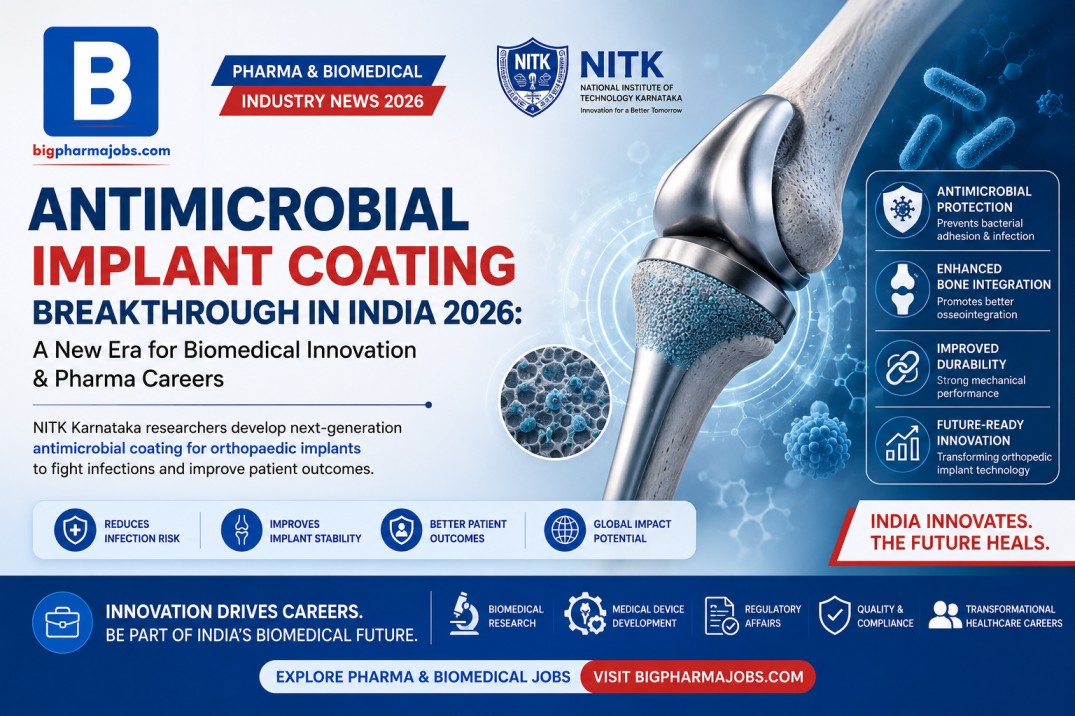
NITK Researchers Develop Antimicrobial Coating for Orthopaedic Implants: A Major Innovation in India’s Healthcare Technology Sector
India’s healthcare innovation ecosystem continues to evolve rapidly, and a recent breakthrough by researchers at the National Institute of Technology Karnataka (NITK) has attracted significant attention across the pharmaceutical, biotechnology, and medical device industries.
Researchers at NITK have developed an advanced antimicrobial coating for orthopaedic implants designed to reduce the risk of implant-associated infections — one of the most critical complications in orthopaedic surgeries worldwide.
The development represents an important step toward safer implant technologies and highlights the growing role of Indian research institutions in medical innovation, biomaterials science, and advanced healthcare engineering.
For pharmaceutical professionals, medical device specialists, biotech researchers, regulatory experts, and healthcare recruiters, this innovation also signals emerging career opportunities in one of the fastest-growing segments of India’s healthcare industry.
Why Implant Infections Remain a Major Healthcare Challenge
Orthopaedic implants are widely used in procedures such as:
Knee replacement surgeries
Hip replacement surgeries
Trauma fixation procedures
Spinal implants
Bone reconstruction surgeries
While these implants have transformed patient outcomes, post-surgical infections remain a major clinical concern.
Implant-associated infections can lead to:
Severe inflammation
Implant failure
Multiple corrective surgeries
Longer hospitalization periods
Increased healthcare costs
Higher patient morbidity
One of the primary reasons infections become difficult to treat is the formation of bacterial biofilms on implant surfaces. These biofilms protect bacteria from antibiotics, making conventional treatments less effective.
This is where antimicrobial coating technologies are becoming increasingly important.
What Makes the NITK Antimicrobial Coating Significant?
The newly developed antimicrobial coating by NITK researchers is designed to inhibit bacterial growth on implant surfaces while improving biocompatibility.
The innovation aims to:
Prevent microbial colonization
Reduce biofilm formation
Improve implant longevity
Enhance patient safety
Lower post-operative infection risks
This advancement could potentially improve surgical outcomes in orthopaedics while reducing the dependency on prolonged antibiotic therapies.
As antimicrobial resistance continues to rise globally, preventive biomaterial technologies like these are gaining strong attention from healthcare innovators, pharmaceutical companies, and regulatory agencies.
Growing Demand for Antimicrobial Biomaterials in India
India’s medical device and biomaterials market is expanding rapidly due to:
Rising orthopaedic surgeries
Growing aging population
Increased healthcare access
Expansion of private hospitals
Medical tourism growth
Rising investments in healthcare R&D
The demand for advanced implant technologies has also increased significantly after the pandemic, with hospitals focusing more heavily on infection prevention and patient safety.
This trend is creating strong demand for professionals across:
Pharmaceutical R&D
Biomaterials engineering
Clinical research
Regulatory affairs
Quality assurance
Medical device manufacturing
Validation and compliance
Healthcare technology innovation
For pharma and biotech professionals, interdisciplinary expertise combining life sciences and medical technology is becoming increasingly valuable.
How This Innovation Impacts India’s Pharmaceutical Industry
Although the innovation originates from the medical device segment, its implications extend deeply into the pharmaceutical industry.
1. Increased Focus on Combination Technologies
The future of healthcare is moving toward integrated technologies that combine:
Drug delivery systems
Biomaterials
Nanotechnology
Surface engineering
Antimicrobial science
Pharmaceutical companies are increasingly collaborating with medical device manufacturers to develop infection-resistant therapeutic solutions.
2. Expansion of Pharma R&D Careers
Innovations like antimicrobial implant coatings are accelerating hiring demand for:
Microbiologists
Biomaterials scientists
Pharmaceutical researchers
Validation experts
Analytical scientists
Clinical data professionals
Regulatory specialists
Professionals with cross-functional expertise are becoming highly attractive to employers in India’s evolving healthcare ecosystem.
3. Growth in Regulatory and Compliance Opportunities
Advanced implant technologies require strict compliance with:
CDSCO regulations
ISO standards
Biocompatibility guidelines
Sterility validation protocols
Clinical safety standards
This creates strong career opportunities in regulatory affairs and quality compliance roles.
Emerging Career Opportunities in Medical Devices & Pharma
As India strengthens its healthcare manufacturing ecosystem, demand is increasing for specialized talent in:
High-Demand Job Roles
Medical Device Regulatory Affairs Executive
Biomaterials Research Scientist
Clinical Research Associate
Validation Engineer
Quality Assurance Specialist
Sterility Assurance Professional
R&D Formulation Scientist
Pharmaceutical Microbiologist
Biomedical Engineer
Orthopaedic Product Specialist
Professionals with expertise in infection prevention technologies and advanced healthcare materials are expected to see strong long-term career growth.
Skills Required for Future Healthcare Innovation Careers
To succeed in emerging pharma-medtech domains, professionals should focus on building skills in:
Biomaterials science
Pharmaceutical microbiology
GMP compliance
Regulatory documentation
Clinical research
Risk management
Medical device regulations
Validation protocols
Sterility assurance
Research methodology
Candidates with interdisciplinary technical knowledge are increasingly preferred by pharmaceutical and medical technology companies.
India’s Rise in Healthcare Innovation and Research
India is steadily positioning itself as a global innovation hub in pharmaceuticals, biotechnology, and medical technology.
Institutions like NITK are contributing significantly by bridging the gap between academic research and industry applications.
Government initiatives such as:
Make in India
Production Linked Incentive (PLI) schemes
MedTech manufacturing support
Biotechnology innovation programs
are further accelerating domestic innovation in healthcare technologies.
This environment is expected to create thousands of new opportunities across pharma manufacturing, biotech R&D, clinical innovation, and medical device production.
Challenges That Still Need Attention
Despite major progress, India’s healthcare innovation ecosystem still faces several challenges:
Limited translational research funding
Regulatory complexity
High commercialization costs
Long product approval timelines
Limited industry-academia collaboration
Global competition in medical technology
However, increasing investments and policy support are gradually improving the innovation landscape.
Future Scope of Antimicrobial Implant Technologies
The future of antimicrobial implant coatings looks highly promising due to increasing concerns around hospital-acquired infections and antibiotic resistance.
Future applications may include:
Dental implants
Cardiac implants
Surgical instruments
Catheters
Prosthetics
Trauma devices
Smart implant technologies
The integration of nanotechnology, AI-driven healthcare analytics, and biomaterials engineering could further transform the next generation of implantable medical devices.
What This Means for Pharma & Healthcare Job Seekers
For candidates planning long-term careers in healthcare, innovations like this indicate where the industry is heading.
The future pharmaceutical workforce will increasingly require expertise that combines:
Science
Technology
Compliance
Research
Innovation
Digital healthcare understanding
Professionals who continuously upskill in emerging healthcare technologies are likely to gain a strong competitive advantage in India’s evolving pharma job market.
Why BIG PHARMA JOBS Tracks Healthcare Innovation Trends
At BIG PHARMA JOBS, we closely monitor innovations shaping the future of pharmaceuticals, biotechnology, and medical technology industries.
As India’s leading pharmaceutical recruitment platform under BIG IDEAS HR Consulting Pvt. Ltd., we help connect skilled professionals with leading pharma, biotech, and healthcare employers across India.
With:
16+ years of recruitment expertise
25,000+ successful placements
Partnerships with 1,000+ pharma companies
BIG PHARMA JOBS continues to support professionals in identifying high-growth career opportunities across India’s healthcare ecosystem.
Key Takeaways
NITK researchers developed an antimicrobial coating for orthopaedic implants.
The innovation aims to reduce implant-related infections and improve patient safety.
Antimicrobial biomaterials are becoming increasingly important in modern healthcare.
The development creates strong opportunities in pharma, biotech, medical devices, and regulatory careers.
India’s healthcare innovation ecosystem is expanding rapidly with strong long-term growth potential.
Frequently Asked Questions
What is an antimicrobial coating for orthopaedic implants?
An antimicrobial coating is a protective surface layer applied to implants to prevent bacterial growth and reduce infection risks after surgery.
Why are implant infections dangerous?
Implant infections can lead to implant failure, repeated surgeries, longer recovery periods, and severe complications for patients.
How does this innovation impact the pharmaceutical industry?
The innovation supports growth in biomaterials research, infection prevention technologies, regulatory affairs, and healthcare R&D sectors.
What careers are growing in medical devices and pharma?
Roles in regulatory affairs, biomaterials science, validation, quality assurance, clinical research, and pharmaceutical microbiology are seeing increased demand.
Why is India becoming important in healthcare innovation?
India is benefiting from rising R&D investments, government support programs, strong pharmaceutical manufacturing capabilities, and expanding medical technology infrastructure.
Weekly newsletter
Get the latest blog updates, practical hiring insights, and featured reads delivered straight to your inbox.
Read about our Privacy Policy.