
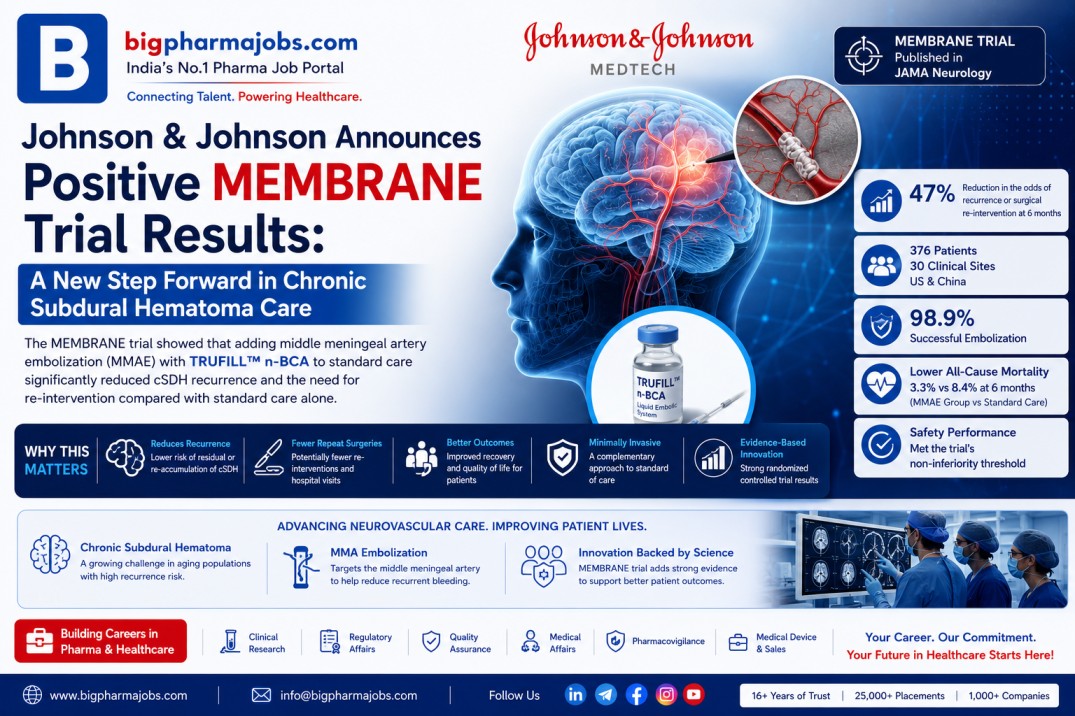
Johnson & Johnson Announces Positive MEMBRANE Trial Results: A New Step Forward in Chronic Subdural Hematoma Care
For patients living with chronic subdural hematoma, treatment can be difficult even after the initial diagnosis is made.
The condition often affects older adults and medically complex patients. While surgery and standard clinical management can be effective, recurrence remains a major concern. Some patients may require repeat procedures, longer monitoring, and additional hospital care.
Johnson & Johnson has now announced positive primary results from the MEMBRANE randomized controlled trial, published in JAMA Neurology. The study found that adding middle meningeal artery embolization, also known as MMAE, with TRUFILL n-BCA to standard of care reduced chronic subdural hematoma recurrence and the need for re-intervention compared with standard care alone.
The findings add important randomized evidence to a growing area of neurovascular innovation: using minimally invasive embolization to improve outcomes in chronic subdural hematoma management.
What Is Chronic Subdural Hematoma?
Chronic subdural hematoma, commonly called cSDH, occurs when blood collects between the surface of the brain and its outer protective covering.
It is often associated with:
Falls or minor head injuries
Aging-related brain changes
Blood-thinning medicines
Medical complexity in older patients
Increased risk of recurrent bleeding
Symptoms can vary and may include headache, confusion, weakness, balance problems, memory changes, or reduced consciousness.
Because cSDH is more common in aging populations, it is becoming an increasingly important neurological and healthcare burden worldwide.
What Was the MEMBRANE Trial?
The MEMBRANE study was a prospective, multicenter, open-label randomized controlled trial.
It evaluated whether adding middle meningeal artery embolization with TRUFILL n-BCA to standard of care could improve outcomes for patients with chronic subdural hematoma.
The trial included:
376 patients
30 clinical sites
Sites across the United States and China
Both surgical and non-surgical treatment pathways
Participants were randomized to receive either:
Standard of care alone
Standard of care plus middle meningeal artery embolization with TRUFILL n-BCA
This design allowed researchers to evaluate the role of embolization across a broad range of chronic subdural hematoma treatment situations.
What Did the Trial Find?
The primary result was clear.
Patients treated with standard of care plus MMA embolization were significantly less likely to experience either:
Residual or re-accumulation of chronic subdural hematoma greater than 10 mm, or
A need for surgical re-intervention within six months
According to the study findings, this represented a 47% reduction in the odds of reaching the prespecified composite primary endpoint compared with standard care alone.
That matters because recurrence is one of the biggest challenges in chronic subdural hematoma treatment.
A reduction in recurrence may mean fewer repeat procedures, fewer hospital visits, and potentially improved recovery for patients.
Other Important MEMBRANE Trial Findings
Beyond the primary endpoint, the trial reported several additional encouraging outcomes.
Lower All-Cause Mortality Trend
The embolization group had a numerically lower all-cause mortality rate at six months:
3.3% in the MMAE group
8.4% in the standard-care-alone group
While the study was not necessarily designed to prove a mortality benefit, the difference is clinically notable and supports further research.
Strong Procedural Success
Successful embolization was achieved in 98.9% of cases.
This suggests that the procedure can be performed with a high level of technical success in experienced clinical settings.
Safety Performance
MMA embolization met the trial’s non-inferiority threshold, supporting an encouraging safety profile when used alongside standard care.
Together, these findings strengthen the case for considering MMA embolization as part of a more comprehensive approach to chronic subdural hematoma management.
What Is Middle Meningeal Artery Embolization?
Middle meningeal artery embolization is a minimally invasive neurovascular procedure.
During the procedure, a specialist guides a catheter through the blood vessels to the middle meningeal artery, which supplies the membranes associated with chronic subdural hematoma.
An embolic material is then used to reduce blood flow to the vessels that may contribute to continued bleeding or fluid accumulation.
In the MEMBRANE trial, the embolic agent used was TRUFILL n-BCA.
The goal is not to replace all standard treatments. Instead, MMAE may complement surgical or non-surgical care by helping reduce the biological processes that contribute to hematoma recurrence.
Why the MEMBRANE Results Matter
The MEMBRANE trial is important because it provides randomized controlled evidence.
In medicine, randomized trials are considered among the strongest forms of clinical evidence because they help compare treatment approaches under structured conditions.
For chronic subdural hematoma, this study adds to a growing body of research suggesting that MMA embolization could become a valuable treatment strategy.
The potential benefits include:
Lower recurrence risk
Reduced need for repeat surgery
More treatment options for medically complex patients
A minimally invasive complement to standard care
Improved care pathways for older patients
As populations age globally, the need for safer and more effective cSDH treatment strategies is likely to increase.
Johnson & Johnson’s Growing Focus on Neurovascular Innovation
The MEMBRANE trial also reflects the growing role of MedTech companies in advancing evidence-based neurological care.
Johnson & Johnson MedTech has continued to invest in neurovascular technologies designed to support physicians treating complex conditions involving the brain and blood vessels.
The positive MEMBRANE findings position TRUFILL n-BCA as an important technology in the evolving cSDH treatment landscape.
More broadly, the trial highlights how innovation in medical devices is increasingly being supported by rigorous clinical research, not only technical performance data.
What This Means for Healthcare Professionals
For neurologists, neurosurgeons, interventional neuroradiologists, and neurovascular teams, the MEMBRANE findings may influence future discussions around treatment planning.
The study suggests that MMAE could have a role across both surgical and non-surgical treatment pathways.
However, patient selection remains critical.
Treatment decisions should consider:
Hematoma size and severity
Neurological symptoms
Recurrence risk
Patient age and comorbidities
Anticoagulant or antiplatelet use
Surgical suitability
Availability of neurovascular expertise
The study adds evidence, but clinical decisions must remain individualized.
Career Opportunities in Neurovascular MedTech
Clinical innovation in neurovascular care also creates growing opportunities for healthcare and life-sciences professionals.
As more advanced treatment technologies enter clinical practice, demand can increase across:
Clinical Research
Medical Affairs
Clinical Application Specialists
Regulatory Affairs
Quality Assurance
Medical Device Sales
Product Management
Clinical Data Management
Neurovascular Nursing
Interventional Radiology Support
For professionals interested in the intersection of medical devices, clinical evidence, and patient outcomes, neurovascular MedTech is becoming an increasingly important career area.
The Future of Chronic Subdural Hematoma Management
The MEMBRANE trial reinforces an important shift in modern healthcare.
Treatment is moving beyond responding only after a complication occurs. The focus is increasingly on reducing recurrence, improving long-term outcomes, and minimizing the need for repeat intervention.
MMA embolization may become a more established part of chronic subdural hematoma care as additional research, real-world evidence, and clinical guidelines continue to evolve.
For patients and healthcare systems, the goal remains the same:
Better outcomes, fewer repeat procedures, and more effective care for a condition that can significantly affect quality of life.
Key Takeaways
Johnson & Johnson announced positive primary results from the MEMBRANE randomized controlled trial.
The study evaluated MMA embolization with TRUFILL n-BCA plus standard care in chronic subdural hematoma.
The combination reduced the odds of recurrence or surgical re-intervention by 47% compared with standard care alone.
The trial included 376 patients across 30 sites in the United States and China.
Successful embolization was achieved in 98.9% of procedures.
The findings add randomized evidence supporting MMA embolization in chronic subdural hematoma management.
The development highlights growing innovation in neurovascular MedTech and clinical research.
About BIG PHARMA JOBS
BIG PHARMA JOBS, powered by BIG IDEAS HR Consulting Pvt. Ltd., connects pharmaceutical, biotechnology, healthcare, and medical device professionals with career opportunities across India.
With 16+ years of recruitment expertise, 25,000+ successful placements, and partnerships with 1,000+ healthcare and life-sciences organizations, BIG PHARMA JOBS helps professionals stay informed about the innovations shaping the future of healthcare careers.
Weekly newsletter
Get the latest blog updates, practical hiring insights, and featured reads delivered straight to your inbox.
Read about our Privacy Policy.