
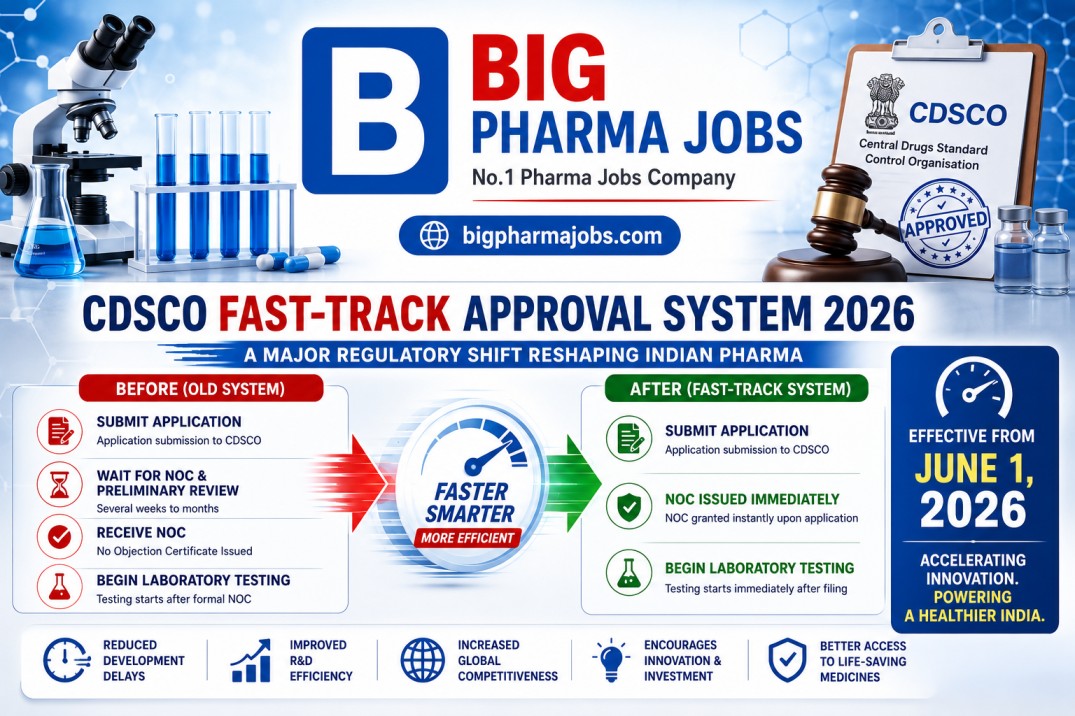
CDSCO Fast-Track Approval System 2026: A Major Regulatory Shift Reshaping Indian Pharma
India’s pharmaceutical regulatory landscape has entered a transformative phase.
The implementation of the CDSCO fast-track approval system in 2026 marks one of the most significant shifts in India’s drug development ecosystem in recent years. By allowing companies to begin laboratory testing immediately after application submission, this new system aims to dramatically reduce approval delays and accelerate the journey from molecule to market.
For pharmaceutical companies, researchers, and job seekers, this is not just a policy update—it is a structural change in how India develops and approves medicines.
🇮🇳 What Has Changed in CDSCO Approval Process?
Traditionally, drug approval in India involved sequential regulatory steps, where companies often had to wait for formal approvals before initiating certain stages of testing.
Under the new fast-track system (effective June 1, 2026), pharmaceutical companies can now:
Begin laboratory testing immediately after application submission
Reduce idle waiting time in early development stages
Accelerate preclinical validation workflows
Streamline regulatory communication cycles
This shift represents a move toward a parallel-processing model, where regulatory review and early-stage testing can progress simultaneously.
⚡ Why This Regulatory Shift Is So Important
India’s pharmaceutical industry has long been known for its strength in generics, manufacturing, and global supply chains.
However, drug development timelines have often been slowed due to regulatory bottlenecks in early-stage approvals.
The CDSCO fast-track system directly addresses this issue by:
1. Reducing Development Delays
Earlier testing initiation means faster progression from concept to clinical readiness.
2. Improving R&D Efficiency
Companies can optimize laboratory utilization and reduce downtime.
3. Increasing Global Competitiveness
Faster timelines help India align more closely with global regulators like the FDA and EMA.
4. Encouraging Innovation
Shorter approval cycles encourage companies to invest more in novel drug discovery.
🧬 Impact on Pharma Industry & Drug Development Lifecycle
This regulatory reform has a direct impact on multiple stages of pharmaceutical development:
🧪 Preclinical Research
Faster initiation of toxicology and lab testing
Improved workflow continuity
Reduced waiting periods between regulatory steps
🧫 Clinical Trial Preparation
Earlier transition from preclinical to clinical phases
Faster IND-enabling studies
Improved trial planning efficiency
🏭 Manufacturing Readiness
Earlier scale-up planning
Better production forecasting
Reduced time-to-market pressure
👩🔬 Key Impact on Pharma Job Market
One of the biggest ripple effects of this reform will be seen in pharma employment trends in India.
📌 High-Demand Functions Will Include:
Regulatory Affairs (RA)
With faster submissions and parallel reviews, regulatory professionals will play a more strategic role in:
Application filing
Documentation management
Regulatory coordination
Compliance tracking
Quality Assurance (QA)
QA teams will see increased responsibility in:
Early-stage compliance monitoring
Documentation audits
GLP/GMP alignment during testing
Clinical Trial Operations
Clinical teams will benefit from faster readiness timelines, increasing demand for:
Clinical Research Associates (CRA)
Clinical Trial Managers
Study Coordinators
📊 Why This Aligns With Global Regulatory Trends
India’s CDSCO fast-track system reflects a broader global movement toward:
Adaptive regulatory pathways
Risk-based approvals
Parallel development models
Faster access to critical medicines
Regulators like the FDA (USA) and EMA (Europe) have already introduced accelerated pathways for:
Orphan drugs
Breakthrough therapies
Life-saving treatments
India’s move signals its intention to strengthen global regulatory alignment and improve innovation competitiveness.
🚀 Opportunities for Pharma Companies
Pharmaceutical companies operating in India now have a strategic advantage:
Faster Time-to-Market
Reduced approval bottlenecks allow quicker commercialization.
Lower Development Costs
Shorter timelines reduce operational and overhead costs.
Improved Innovation Pipeline
Companies can progress more molecules simultaneously.
Stronger Global Positioning
Faster approvals enhance export and partnership opportunities.
🧠 Strategic Industry Insight
From an industry perspective, this change will likely lead to:
Increased R&D investment in India
Expansion of regulatory teams
Growth in contract research organizations (CROs)
Higher demand for skilled scientific professionals
Stronger integration of digital regulatory systems
This is not just a procedural update—it is a pharmaceutical ecosystem upgrade.
📉 Challenges Ahead
While the system improves speed, it also introduces new challenges:
Higher pressure on regulatory documentation accuracy
Need for stronger compliance systems
Increased workload in early-stage testing coordination
Risk of operational overload for small companies
Companies will need to invest in stronger regulatory infrastructure and skilled professionals to fully benefit from this system.
🔮 Future Outlook
The CDSCO fast-track approval system could become a foundation for:
AI-driven regulatory submissions
Digital-first drug approval systems
Real-time compliance tracking
Integrated global regulatory alignment
If implemented effectively, India could significantly reduce its drug development timelines over the next decade.
🎯 Key Takeaways
CDSCO has activated a fast-track drug approval system in 2026.
Companies can now begin lab testing immediately after application submission.
The reform significantly reduces drug development timelines.
Regulatory Affairs, QA, and Clinical Operations will see higher demand.
India is aligning its regulatory ecosystem with global standards.
The change is expected to boost innovation and pharma job opportunities.
💼 Looking for Pharma Jobs in This Evolving Industry?
With regulatory systems becoming faster and more complex, pharmaceutical companies are actively hiring skilled professionals.
BIG PHARMA JOBS helps pharma candidates connect with top employers across India in:
Regulatory Affairs
Clinical Research
Pharmacovigilance
Quality Assurance
Manufacturing & R&D
Stay ahead of industry changes and build your career in India’s evolving pharmaceutical ecosystem.
❓ Frequently Asked Questions
What is the CDSCO fast-track approval system?
It is a regulatory reform allowing pharma companies in India to begin laboratory testing immediately after submitting drug applications.
How does it impact drug development timelines?
It significantly reduces early-stage delays, allowing faster progression from application to clinical trials.
Which pharma roles benefit most?
Regulatory Affairs, Quality Assurance, Clinical Research, and R&D roles will see increased demand.
Does this align India with global regulators?
Yes, it moves India closer to FDA and EMA-style accelerated approval frameworks.
Weekly newsletter
Get the latest blog updates, practical hiring insights, and featured reads delivered straight to your inbox.
Read about our Privacy Policy.